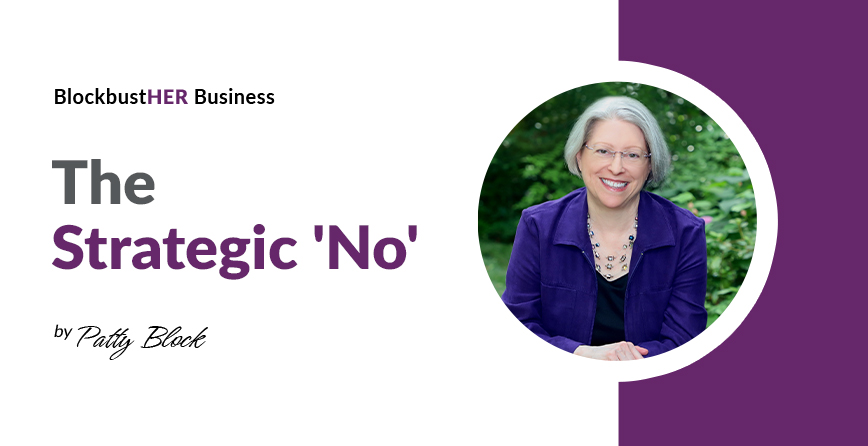
The Strategic 'No'
“The oldest, shortest words—'yes' and 'no'—are those which require the most thought.’ – Pythagoras, ancient Greek philosopher and mathematician.
I’m not a gambler but I bet I can trace your early business success to one singular habit: saying yes.
Yes to clients who needed help. Yes to opportunities that stretched your skills. Yes to solving problems that weren’t clearly defined yet.
That willingness built momentum, reputation, and trust—often faster than any formal strategy. But what builds a business is not what sustains its value…
Today’s BlockbustHER BrainteasHER:
What’s one ‘yes’ you’ve been giving for years that is now costing your company?
Patty’s Perspective . . .
At a certain stage of maturity, continued business growth depends less on expansion and more on discernment. That shift is powered more often by ‘no’ than it is by ‘yes’.
- Opportunity Cost Is a Valuation Issue
Every ‘yes’ has a cost, whether it’s visible or not. Time, attention, team capacity, and brand focus are finite resources. When a mature firm continues to say ‘yes’ indiscriminately, it spreads those resources thin—often in ways that never show up on a financial statement but are obvious to a buyer.
Buyers don’t just evaluate what your company does. They evaluate what it chooses not to do. A firm that chases every opportunity signals uncertainty about its core value. A firm that is selective signals confidence, clarity, and control.
Opportunity cost isn’t a personal productivity problem. It’s an enterprise value problem.
- Curating Clients Is a Strategic Act
In the early years, taking on a wide range of clients is often necessary. But over time, it becomes clear that not all revenue is created equal.
Some clients demand disproportionate attention. Others resist pricing discipline or blur scope boundaries. Still others no longer align with your firm’s expertise or direction. Yet many women founders continue to say ‘yes’ out of loyalty, habit, or fear of disruption.
From a growth and exit perspective, this is costly.
High-value firms curate their clients intentionally. They prioritize clients who respect boundaries, value outcomes, and engage as partners rather than purchasers. This curation improves margins, simplifies delivery, and strengthens positioning.
Buyers prefer firms with a clean, high-quality client portfolio. It reduces risk, improves predictability, and makes future growth easier to imagine. Selectivity is not exclusion—it’s optimization.
- Elevating Standards Changes Everything
Saying ‘no’ is often less about rejecting opportunities and more about raising standards.
Standards govern who you hire, what work you accept, how quickly you move, and how you measure success. But perhaps you’re worried that higher standards will reduce flexibility or strain relationships.
In practice, the opposite is true. Clear standards reduce friction because expectations are explicit rather than implied.
From a valuation standpoint, high standards are a proxy for operational maturity. They signal that quality is designed into the system, not dependent on individual effort.
- Refining the Business Model Through Refusal
One of the most powerful ways to refine a business model is to stop doing what no longer serves it.
This might mean retiring legacy services that generate revenue but dilute focus. It might mean declining projects that don’t reinforce your strategic positioning. It might mean saying ‘no’ to growth ideas that are exciting but misaligned with your long-term goals.
Each refusal sharpens the model.
Over time, the business becomes easier to describe, easier to operate, and easier to sell. Its value proposition becomes clearer. Its margins improve. Its delivery becomes more consistent.
Buyers are drawn to businesses that know exactly what they are. Strategic refusal is how that clarity is achieved.
- The Valuation Impact of Selectivity
Selectivity is one of the most underrated drivers of enterprise value.
Firms that say ‘no’ effectively tend to have:
◦ stronger margins due to pricing and scope discipline
◦ clearer differentiation in the market
◦ more predictable operations
◦ less founder dependency
◦ higher-quality teams and clients
◦ cleaner financials and story
All of these reduce perceived risk. And reduced risk increases value.
The power of saying ‘no’ lies in what it makes possible: a business that reflects your expertise, protects your energy, and holds its value over time.
Now What?
Feeling stuck is a signal you’re ready for change—and the best time to design your exit is when you’re successful and stuck.
Have you built a profitable and valuable business but instead of feeling energized and hopeful, you’re feeling quietly exhausted?
In my experience, women don't retire; they transition into a new stage of purpose and impact. Whether you are 40 or 60, the idea of retirement may not appeal to you. Just because you can retire doesn’t mean you’ll want to.
Since 2006, I’ve seen too many women get bad advice, pushing them to exits that leave them feeling demoralized and angry. The exit process is filled with pitfalls and complex issues—especially for women.
That’s why I help women founders achieve an Elegant Exit™—because you deserve better.
In fact, for women running companies under $5M in annual revenue, I’ve come to believe that you have more control, better focus on your real priorities, and better odds of building wealth when you build Living Capital™, instead of trying to sell your business to a stranger (what I call Latent Capital™).
An exit is elegant only if it increases your personal wealth while decreasing the stress required to maintain it.
Anything else is just endurance with better branding.
The Elegant Exit™ is how you convert business success into real wealth—without sacrificing your nervous system to get there.
As your advocate, I’m looking out for your best interests, guiding you to discover right-fit options, execute critical decisions, and cultivate personal wealth.
Contact me to learn more.
What are your biggest blind spots in crafting an exit? Find out at: http://she-exits.com/

A Note from Patty...
My life’s work is empowering high-achieving women business owners to fine-tune their operations and scale their revenue for strategic growth, creating real business value and emerging exit ready. That value can transform into wealth when they are ready to exit their company - and I believe that wealth in the hands of women elevates society as a whole.
Latest Articles
- Your Fork In The Road
- Living Capital™
- 3 Lies We're Sold
- Where Control Lives
- Not One-Size-Fits-All
- Cash is Queen
- The Partial Liquidity Path
- Your Wealth-Building Engine
- The Myth of ‘Someday’ Wealth
- Survival Isn’t Success
- Design Your Next Act First
- Strategic Scaffolding
- The Elastic Business
- When Profit Lies
- The Strategic 'No'

Your Hidden Advantage
Unlock the Power to Attract Right-fit Clients and Boost Your Revenue